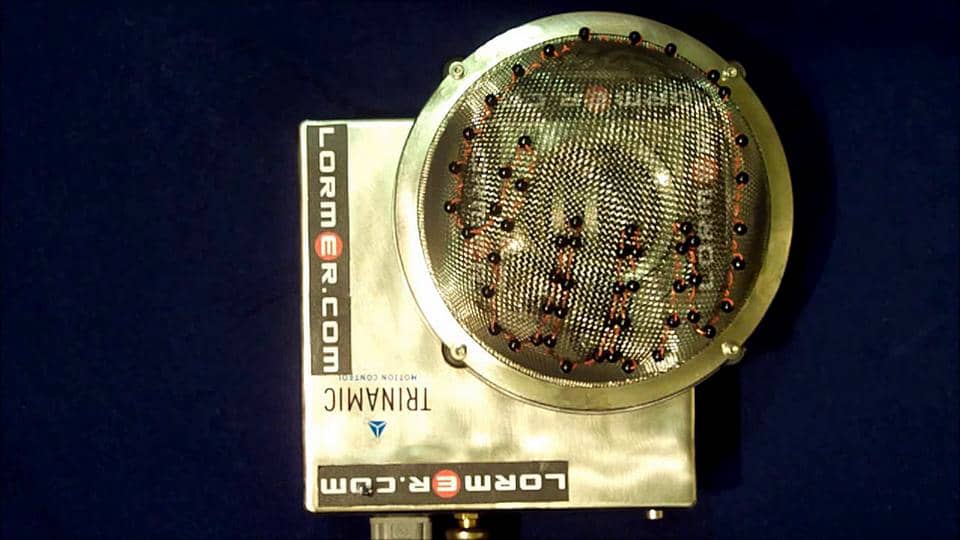
In this video you can see how the lormer is working.
In diesem Video sieht man wie der Lormer funktioniert.
Hieronymus Lorm - selbst taubblind - entwickelte Mitte des 19. Jahrhunderts ein Tastalphabet, um mit seinen Mitmenschen kommunizieren zu können.
Dabei wird die Handinnenfläche an bestimmten Stellen berührt. Diesen Berührungspunkten und –linien sind jeweils Buchstaben und Buchstabenkombinationen zugeordnet, die zu Wörtern und Sätzen zusammengefügt werden. Das so genannte Lormen ist für viele taubblinde Menschen bis heute die wichtigste Kommunikationsform.
Einige von ihnen beherrschen zwar auch die Blindenschrift (Braille) und sind deshalb in der Lage, zu lesen und zu schreiben und so am öffentlichen Leben teilzunehmen. Aber wer die Brailleschrift nicht kennt, z.B. weil sie aufgrund später Erblindung im Alter nicht erlernt wurde, ist immer auf einen Übersetzer angewiesen, der Informationen durch lormen übermittelt. Dadurch wird der selbstbestimmte Zugang zu Informationen erschwert. Klicken Sie hier um mehr über eine nützliche Erfindung für taubblinde Menschen zu lernen.
Mit dem Lormer können taubblinde Menschen ohne fremde Hilfe jeden maschinenlesbaren Text lesen und mit anderen kommunizieren. Der Lormer ist ein an einen Computer angeschlossenes Gerät, das Bewegungen, wie sie beim Lormen oder bei anderen Tastalphabeten angewandt werden, fast wie ein Mensch ausführen kann.
Während die Hand auf einem speziellen Sieb ruht, bewegt eine darunter angebrachte, computergesteuerte Mechanik einen Luftdüse, welche mit einem Druckluftstrahl Buchstaben in die Handinnenfläche zeichnet. Die Lesegeschwindigkeit ist mit dem Lormer in etwa so hoch wie bei einer im Lormen sehr geübten Person. Der Lormer zeichnet jede beliebige, dreidimensionale Bewegung auf, ordnet sie einer vorgegebenen Bedeutung – einem Buchstaben oder Zeichen - zu und gibt sie wieder.
Jede Bewegung kann individuell und auf die Handgröße angepasst, gespeichert und wiedergeben werden. Die Software ist so programmiert, dass mehrere Profile für verschiedene Nutzer angelegt werden können. Mit jedem Profil werden die Handgröße und die persönlichen Einstellungen wie z.B. die Geschwindigkeit sowie Texte gespeichert. Ein Benutzerprofil kann durch einen Fingerabdrucksensor vor unberechtigtem Zugriff geschützt werden. Dadurch wird die Privatsphäre des Taubblinden gewahrt, wenn das Gerät von mehreren Benutzern in einer Einrichtung für Taubblinde benutzt wird. Das Bild zeigt ein Gamepad wie es auch bei Computerspielen benutzt wird.
Damit wird der Lormer von der taubblinden Person bedient.Die wichtigsten Funktionen des Lormers lassen sich von taubblinden Menschen mit wenigen Tasten sehr einfach über einen Force Feedback Gamepad bedienen. Daneben kann das Gerät auch über die Tastatur sowie mit der Maus und mit Sprachbefehlen gesteuert werden. Durch unterschiedliche Vibrationen des Gamepad wird signalisiert, wann der Buchstabe, das Wort oder der Satz zu Ende ist. Des Weiteren werden so Befehlsbestätigungen oder Statusmeldungen an den Nutzer gegeben, die zusätzlich per Sprachausgabe und über den Monitor erfolgen, so dass die Bedienung auch durch nicht-taubblinde Menschen bzw. Hilfspersonen einfach möglich ist.
Der Lormer bietet vielfältige Kommunikations- und Informationsmöglichkeiten: taubblinde Menschen können Worddokumente, Emails, Webseiten und Drucksachen aller Art, die eingescannt werden, lesen. Da das Gerät über eine Sprachausgabe und eine Spracherkennung verfügt, können in ein Mikrofon gesprochene Texte direkt in Lormbewegungen übersetzt werden. Der Sprecher hört den vom Computer verstandenen Text zur Kontrolle über die Sprachausgabe und kann diesen im Bedarfsfall direkt ebenfalls per Sprachbefehl korrigieren.
Die Software kann auch auf einem Mobiltelefon mit Windows 8 oder einem Tablet PC eingestzt werden.
Das Bild zeigt ein Microfon, in das gesprochen werden kann, der verstandene Text wird dann in Lormen übersetzt. Der Taubblinde kann aber auch auf diegesprochenen bzw. gelormten Texte reagieren und so in einen direkten Dialog treten. Über die Tastatur gibt er seine Antwort ein. Synchron zum Tastendruck wird der entsprechende Buchstabe zur Kontrolle in seine Hand gelormt.
Auf diese Weise erkennt der taubblinde Benutzer die Anordnung der Tasten auf der Tastatur und kann so das selbständige Verfassen von Texten erlernen. Der Lormer eignet sich besonders für Einrichtungen, in denen Taubblinde betreut werden.Durch die Vernetzung mehrerer Lormer können gleichzeitig mehrere taubblinde Schüler von einem Lehrer unterrichtet werden.
Der Wortschatz taubblinder Menschen ist oft von relativ geringem Umfang, so dass zum Verständnis eines Textes häufig Worterläuterungen notwendig sind. Die Software des Lormers verfügt über ein eingebautes Lexikon und kann außerdem durch nur einen Knopfdruck weitere Erläuterungen online abrufen. Dadurch wird einerseits der Wortschatz erweitert und andererseits können Betreuer Wissenslücken erkennen und so die taubblinden Schüler zielorientiert fördern.
Der Lormer ermöglicht taubblinden Menschen einen selbstbestimmten Zugang zu Informationen und verbessert Ihre Kommunikationsmöglichkeiten - ohne das Kenntnisse der Blindenschrift notwendig sind!
____________________________________-
There are around 5000 deafblind people living in Germany. These people can neither hear nor see and as a consequence they also have difficulty in speaking In order to understand the world, they are entirely dependent on their sense of touch. Hieronymus Lorm – who became deaf at the age of 15 and then found that his eyesight was failing - developed in the middle of the 19th Century a touch or manual alphabet, in order to be able to communicate with his fellow men. The Lormen is a form of communication for deafblind to communicate with other people, named after Hieronymus Lorm.
"Talking" is done by directly tracing lines & shapes on the "readers" palm. The Lorm alphabet assigns letters & numbers to individual fingers or to more than one finger. When both partners are practiced in Lormen, the communication is very quick. Lormen is the dominant mode of communication with deaf blind people & between deaf blind people. Some deafblind people can read Braille and are therefore able to read and write and can participate more fully in life.
But those who do not know Braille, for example because they became blind at a relatively late age, are always dependent on a human translator to convey information physically using the Lormen language. Access to most information is more difficult for those people who cannot use Braille. Click here to learn more about a useful invention for deafblind people! The Lormer is a machine invented by Thomas Rupp which translates machine text into movement. It assigns a defined meaning to particular motion - a letter or a sign - and reproduces it. This movement is then applied by a stylus in Lormen lines to a hand resting on a comfortable metal grid (like a kitchen sieve). The Lormer registers and stores three dimensional motion. Each motion can be tuned or set individually and matched to the size of any hand, and can be stored and retrieved.
Using the Lormer deafblind people can read and access machine readable text without external assistance or translation and can therefore communicate directly with others. The software is programmed in such a way that several profiles for different users can be stored. For each user profile the Lormer stores such details as the hand size and other personal attributes such as speed. A user profile can be protected by a fingerprint sensor against unauthorized access. Thus the privacy of the deafblind is protected, if the equipment is used by several users.
The most important functions of the Lormer can be utilized made by deafblind users with few keys and very simply using a Force feedback Gamepad. The Lormer can also be operated via a keyboard or a mouse or using normal speech the spoken word. Gamepad vibration signals the end of words and sentences to the user of the Lormer. The moreover one command confirmations or status messages are given in such a way to the user, who is made additionally by acoustic output and by the monitor, so that the operation is simply possible also by non-deafblind humans and/or auxiliary persons. The messages sent by the deafblind person are also shown in text on the computer screen and are also delivered orally by the computer so that helpers can also understand the communications which are going on.
The Lormer offers many and various communication and information possibilities: deafblind people can, using the Lormer, read Word documents, emails, web pages and printed text of all kinds. Since the Lormer has an acoustic output and a speech recognition function, spoken text can be translated directly into Lormmoves through a microphone. The computer repeats the spoken text orally and shows it on screen to ensure that the speaker can be certain that an accurate rendering of the text is made before it is Lormered. The speaker hears the text understood about the computer as a check of the acoustic output and can this if necessary directly likewise by language instruction correct. The deafblind can also react immediately directly to the spoken and/or Lormered text and communicate directly in real time with other people in this way. A keyboard is used by the deafblind person to enter an answer. Simultaneously as the user depresses a key the appropriate letter is Lormered as a check into the hand of the deafblind user. In this way the deafblind user recognizes the arrangement of the keys on the keyboard and can then learn how to write text independently the independent writing of text.
The Lormer is particularly suitable for institutions, in which deafblind people are cared for. Several deafblind pupils can be taught (by networking of several Lormer) at the same time by a teacher. The vocabulary of deafblind humans is often relatively limited, so that to understand a text frequent explanations of words are necessary. In order to accommodate this problem the Lormer has an on line encyclopedia function and can call up further explanation by the mere push of a button. Thus on the one hand the vocabulary of the user is extended and on the other it is possible for helpers to work out which words or phrases cannot be understood by the deafblind person. This enables the helpers to provide assistance. Knowledge gaps can be recognized by helpers and so the deafblind pupils can be given targets to meet in their advancement. The Lormer makes access to vast amounts of previously unavailable information for deafblind people possible and improves communication possibilities - without such technology knowledge of Braille is necessary!